Showing posts with label My Experiences. Show all posts

Friday, September 11, 2020

Virtual Presentations

Due to Coronavirus and Lockdown, this year we couldn't arrange presentations at our Department. As a solution for this situation, we have submitted the presentations and assignments virtually. 
Here I am sharing links of my presentations on YouTube. 

👉My Presentations of MA Semester IV

1. Indian Poetics

2. American Literature

3. Literary Theories

4. Research Methodology

5. Indian Literature in Translation 

Sunday, June 7, 2020

Human Resource Development in Higher Education after Covid 19

A webinar on “Human Resource Development in Higher Education after Covid 19” organised by Bhakta Kavi Narsinh Mehta University Junagadh on 7th June 2020 

Here, I am sharing my experience of attending this webinar. 

First of all, Dr Om P Joshi sir  introduced all about this webinar.Then Honourable VC Prof Dr Chetan Trivedi sir delivered the welcome speech. He talked about various digital initiatives taken by Bhakta Kavi Narsinh Mehta University and also mentioned about upcoming exams of UG and PG. 

Then Dr Om Joshi  invited the first speaker Prof  Dr Jagdish Joshi Sir to deliver an expert talk. 

Following are some major points which he has discussed. 

👉Three main pillars for Human Resource Development in Higher Education: 
🎓🎓🎓STUDENTS, ACADEMICIANS, ADMINISTRATIONS 🎓🎓🎓

👉Three remarkable phases in the  History of World: Pre Corona, Corona, Post Corona 

👉Four important things: 
✍️✍️Train teachers and students for online education 
✍️✍️Creation and use of e-content
✍️✍️Initiate online classrooms 
✍️✍️ ICT Support for teachers 

👉To be ready with Rescue management, Disaster management, and Crisis management in Post CoviD19 

He quoted our Honourable Prime Minister Narendra Modiji👇 

 
👉He inspired teachers not to be afraid of Online teaching but to initiate it with handy tools 

Then Dr Om Joshi  invited the second speaker Ms Parin Somani  to deliver an expert talk. Following are the major points she discussed. 

👉CoviD19 

👉Aim, and role of  HRD 

 
👉Teaching before CoviD19, during CoviD19, Future of Higher education 

 
Then Dr Om Joshi  invited Anju Sharma ma'am to share her views regarding the topic of this webinar. 

She highlighted two points: 

👉To prepare pedagogy and use it effectively in Post CoviD era, to divide the curriculum into two parts: what can be taught online and what can not be?!! 

👉Need of hardworking Academicians and learners as well 

Then Dr Om Joshi requested Honourable Education Minister Bhupendra Sinh Chudasama Sir to bless us with his enlightened views regarding the topic. He congratulated Bhakta Kavi Narsinh Mehta University for organizing such useful webinars and appreciated various digital initiatives taken by the University till date. He also thrown light on various challenges in educational world specially in Primary and Secondary education in future. 

Dr Om P Joshi Sir expressed his gratitude to all on behalf of the University for remaining present in this webinar. 

Friday, May 29, 2020

The Role of English in Acquiring Life Skills for Better Career Prospects

The Role of English in Acquiring Life Skills for Better Career Prospects: A Webinar organised by Sharda University 

The abruptly spreaded Covid 19 and lockdown as a result of it has just stopped the human life in all the fields. But it’s truly said that Necessity is the mother of invention.. in beginning we were shocked, tired and bored but gradually we the human being realise the need of learning, the need of being active in life and we came with a solution in the form of various digital initiatives taken by the government and many institutions and widely accepted by people across the nation or even the entire world. To attend webinars on different topics become a new normal for human life. 

Here I am sharing my experience of attending one such webinar and that is The Role of English in Acquiring Life Skills for Better Career Prospects: A Webinar organised by Sharda University 

Entire the session was coordinated by Ms Pooja Mann and the expert talk was delivered by Prof. Shabina N Omar. Here I am trying to share the overview of her presentation which I have noted down. 

She has simplified the topic of her presentation from the beginning itself by providing a meaning of Life Skills in easy language. 

Then she has differentiated GOOD and EFFECTIVE person. A person having a set of enough life skills which includes both Soft skills and Hard skills.  The list of life skills provided by WHO includes: 

👉 Communication and interpersonal skills 
👉Decision making and Problem solving
👉Creative and critical thinking 
👉Self awareness and empathy (Emotional intelligence) 
👉Assertiveness 
👉Resilience 

Then she has elaborated the Life Skills required in the contemporary life which includes: 

👉Communication 
👉Flexibility
👉Initiative 
👉Social Skill
👉Productivity 
👉Leadership 

Then she discussed the Goal in life, it should be SMART 
 

Then she distinguished Soft skills and Hard skills. Hard skills can be taught in educational institutions by teachers or elders and it is related to IQ  whereas Soft skills are something related to  EQ  and can not be taught but should be acquired from life itself. To require such skills in life language plays an imminent role. And specially English is very useful for a person to acquire skills. 

“Technology helps one to learn many languages but English helps him or her to reach technology itself.” 

A person working in any field or willing to set career in any field will definitely require communication skills and that too in English as it is the Global language and Second language for a number of countries. 
It was followed by question answer session with the expert. 

It was indeed a very good experience to listen such an expert Prof. Shabina Omar . 

Saturday, January 4, 2020

Life Without Internet


Image result for life without internet

We are all connected by the internet like neurons in a giant brain.
We begin the day with internet
and end with the internet. When anyone asks where you use internet I just thought where I don't use internet!!! We use internet to communicate, to connect with the world, we use internet for education; like blogs, wiki, Hotpotatoes, BYJU'S, Google Classroom, Google forms, surveymonkey.com, Audacity, podcasts, ted talk, Massive open online courses MOOCs, and so on, we use internet to access thousands of books immediately, we use internet for entertainment, for shopping, for marketing, for banking, for documentation, for security we have cybercrime branches which also use internet, we use internet to get help immediately, we use BLOOD GUJARAT HELP, we use 181 application, and for researchers internet is bliss, they gain and impart the knowledge on the global platforms like google scholar, research gate, Slideshare, Academia, eltvoices, Sodhganga, Sodhgangotri, online citations like easybib, and citation machine only because of internet. In a way we use internet in almost all major activities of our life, we use it to save our time and money, we use it to make the life easier, and we use it being the part of globalization.

In such a condition, it's indeed tough to imagine a life without Internet. It's also a fact that lots of people have been brought up without internet, without reliance and dependence on internet but in the present world of information communication and technology ICT, to think about the life without internet is just to imagine a day without sunrise, moon without moonlight... it's just next to impossible even to imagine for us for a modern man.

Without internet we'll have only question like a lady in Eliot's The Waste Land asks 
"What shall I do now? What shall I do??"
Our life without internet would be, in the words of T S Eliot,
Shape without form
Shade without colour
Paralyzed force
Gesture without motion  
On the other hand, it is also true that the excessive use of anything is always harmful, in this respect, for those who use internet excessively; a life without internet would be blissfully. As it is said that,
Sleep is for us
Only when
There is no access to internet.


Wednesday, December 18, 2019

Social Media inside the Classroom


Social media: an easiest way to connect with the world, an impressive way to create virtual identity, and nowadays a handy tool to communicate with friends and
other people as well. In short, it’s an easy tool to reach millions of people virtually, to impart knowledge, to share thoughts and lots of things which we love to do.
Social media is not limited just for society but it also entered the classrooms very effectively. It is possible and it often happens that students get distracted only because of social media. Even it may be proved harmful for society as many people specially young generation lose their lives or get depressed in comparison of likes and dislikes, comments of friends and many times because of cyber crimes.
Nevertheless, does social media mean only Whatsapp, facebook, Twitter, Tik Tok, Hangout? No, I don’t think so.  However, there are a number of tools which are the parts of Social media but can be used or I should say are being used for academic purposes in this present era of technological enhancement.
Blogs are very popular and useful tool for sharing material with students. It can be used to enhance the communication skills of the students. Google Classroom is also very helpful tool for teachers as well as learners to share material, assignment collection, and virtual classroom communication. Ted talk is also very helpful for not only motivational talks or knowledge sharing but also for improvement in listening skills.
Hangout or Zoom applications can be used for group discussion among students, teacher can deliver lecture even during holidays from their home and students can learn at their time and place. There are thousands of tools we can consider as a part of social media, which can be fruitful, if we allow them in the classroom.


Monday, November 18, 2019

MOOCs on Swayam: My Experiences


Apart from regular studies, it’s important to learn something new or something related to our syllabus from other resources available in the market, to expand our knowledge. For that,
one of the best options is to join Massive Open Online Courses. I am glad that I have recently completed two online courses on Swayam:


It was a course on Academic Writing, What is AW?, Traits of AW, Plagiarism, How to write AW, and general information regarding Open Educational Resources.

I have joined this course to expand my knowledge regarding Research and Academic Writing.  
  • History of English Language and Literature


It was all about the History of English Language and Literature age wise from Old Age to the Present Era, the contribution of major writers and effects of Socio-Political events on the development of language and literature.

I have joined this course to know the History of English Language and Literature in detail, and it will be helpful to me for the preparation of NET and SET.

Apart from the content, I have learned so many things from courses.
How to communicate with unknown people.
How to manage regular studies and these courses all together.
To create Open Educational Resources on YouTube.
To appear in Online Exams (Proctored)


Tuesday, October 1, 2019

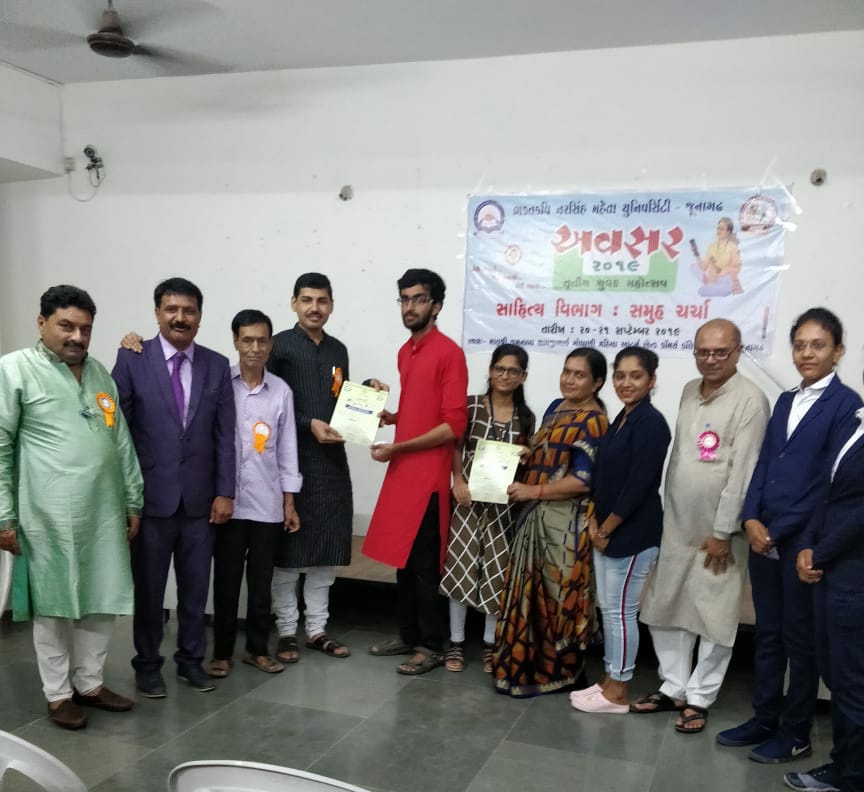
AVASAR 2019: My Experience

Bhakta Kavi Narsinh Mehta University has organized the third Youth Festival AVSAR 2019 on 20th and 21st September 2019 at J S Godhani Mahila Arts and Commerce College Junagadh. 


I have participated in Debate with Neel Maher from Department of Life Science. We have started preparation before fifteen days ago. We have prepared for topics i.e. Social Media, Article 370 and 35A, Traffic rules in India, Demonetization, etc. Before 24 hours of competition, final topics were declared on www.bknmu.edu.in. We were given three topics and we were asked to choose one. It became very easy for us as all the topics were the same which we have prepared. We have selected "Advantages and disadvantages disadvantages of using social media". We have discussed our points on Social Media again and again. We both were fully confident for competition. 

On 20th September, we met in Youth Festival, and on the time of registration for debate, we were informed that you both were not in this competition as your name was not registered there. We have asked them to search BKNMU department etc. but they found nothing so we called Jatin Sir our team manager and he helped us to find out our registered names. Finally we entered the class for competition. We were eagerly waiting for our turn. There were 42 pairs and total 84 participants for debate. Most of all the students have selected the same topic and that is Social Media which we have also selected. We were worried somehow that we have to repeat the same because all will speak on the same topic then they will cover our points and no one will be interested in our discussion at last. But fortunately no one could include our points in their discussion, so we were safe. 

Actually the room was small and the sound of mike was unbearable for us, we were tired, suffering from headache and awaiting for our turn. Though it came last so I thought that wow no one could copy our content otherwise it was possible that others could make their content better after listening to us. All have discussed Social Media keeping in mind Whatsapp, Facebook Twitter and Instagram and Tiktok only. They talked about learning through Social Media but only with Google and YouTube. 

I have started my positive point from the idea that Social Media does not mean only Whatsapp, Facebook, Twitter, Instagram and Tiktok it also includes Google Classroom, Nicenet, Blog, Wiki, Hangout, Zoom, Ted talk and so on for education purpose, Blood Help Gujarat app for health, 181 for women help, very good initiative of government SWAYAM from which we can learn anytime anywhere so many things from experts of various fields. If we want to learn or join courses in Universities of the world we can join edx and cousera. If we talk about cyber crime, it not the disadvantage of social media, for the solution, government has started CyberCrime Branch. So, social media is beneficial for the freedom, protection and education of female, education, health, connectivity and development of our nation through Globalization. I have given real example of our department, how we utilize social media for education. 
Click here to visit my blog on Online learning

Negative points from Neel were also strong. He has included Cyber crime, Cyber bullying, trolling, mob lynching, cyber attack from Western culture on our ancient culture, health issues, increased Pollution caused by technology and social media, harmful radiations, and so on. He has given real life examples and statistical analysis too. 

Listen my speech on this topic :- Click here

Sunday, September 1, 2019

Teacher's Day

As we all know that we celebrate teacher's day in memory of Dr Radhakrishnan. On this special occasion, students become teachers and try to imitate his or her favorite or ideal or role model teacher. This is the best opportunity to be grateful to the milestones of our life, our teachers.

Besides, our parents are the first teachers in our life, especially mother, she is equal to thousands of teachers.

To watch one such short film Click here👇

        The Best Teacher

Sunday, August 11, 2019

Use of ICT tools for English Language Teaching


Development of technology has changed the life of man and way of thinking and working as well. It also affects the forms of communication we use. The change in forms of communication tools, like, earlier we used to write letter and then rare phone calls and now unlimited chats with friends, emails instead of letters, directly affects the way of teaching and learning language. A student using smart phone to communicate will obviously be not interested in learning merely from board instead, s/he would like to learn using various ICT tools. For that, a teacher can use various web 2.0 tools like, Blog, Google Classroom, Wiki, Ted talk, Moodle, and so on.
 Let us discuss how these ICT tools or what we generally call Web 2.0 tools can help for Language teaching and learning.


Blog is a website containing a writer or a group of writers’ own experiences, observations, opinions, etc. and often having images and links to other websites. (dictionary.com)
There are various purposes to use blog, we can connect with people from entire world, we can read others’ ideology and can share our ides with the world, and can comment on others’ blog posts. A teacher can use blog to improve his/her students’ basic communication skills.
Students can read blogs and can create their own blog as well. Teacher can instruct students to read one another’s blogs and make constructive comments. So, in a way, students can improve their reading and writing skills and critical thinking will also be developed.


A podcast is an episodic series of digital audio or video files, which a user can download to listen.
Podcast is the best way to learn language with listening practice. Many students feel bored in reading but can learn very easily with enjoyment while listening. For such students, educational podcasts are appealing and encourage them to learn.
Teachers can create their own podcasts or can suggest students some very good podcasts like eslpod, BBC, etc. Besides, teachers can also help students to make their own podcasts, and then to share in the classroom and allow students to give comments to one another’s podcasts. In this way students’ listening and speaking skills will be improved.


A wiki is a website that allows users to add and update content on the site using their own web browser. Users can collaboratively modify content and structure directly from the web browser.
Wiki is a useful tool for students and researchers to work collaboratively from distant places. With the help of wiki teacher can help students to enhance students’ communicative competence, especially, Reading and Writing skills. Students can work together from their different places and teacher can see what they have done and can edit the content as well. Moreover, students can see what changes their teacher has made in their content.  


Google Classroom and Nicenet are the virtual classes. Google Classroom helps teacher to share material, give instructions and assignments, grade assignments, discussion forum, etc. Nicenet is also one kind of virtual class like Goggle Classroom. The only difference is that Google Classroom is directly connected to Google Drive and Nicenet is not. On the other hand, Nicenet provides video conference facility to teacher and learners but Google Classroom doesn’t.

There are a number of ICT tools available in the market, to teach and learn language. Here I have discussed a few of them. To be an effective language teacher one has to be updated with time and for that, one must have knowledge of technological development apart from their subjects. 

Tuesday, July 30, 2019

Massive Open Online Courses


  • Introduction

There are two types of teaching:
1. Online Teaching
2. Offline Teaching
It was a time when students learnt from books and blackboard but it is a time that students wish to learn from screens. So, nowadays Online Teaching like MOOC, Ted education, Gamification, Blog, etc. are popular among teachers and students. MOOC is one of the most popular among these methods.


  • What is MOOC?
Massive: large number of enrollment of learners
Open: open for all (no mandatory qualification)
Online: fully online
Courses: structured course content   
So, MOOC is an online course aimed at unlimited participation and open access via the web.


  • Basic Philosophy of MOOC

Anytime Anywhere Anyone

  • Platforms for MOOC
Swayam 
Swayam Prabha 
Edx 
Cousera

  • Features of MOOC

  1. E tutorials: Video lectures by subject experts
  2. E content: Reading material
  3. Quiz: Self-assessment and graded quiz
  4. Discussion Forum: Students and teacher can interact

  • Types of Courses on MOOC

  1. Audited Courses: For learning purpose only
  2. Certificate Courses: For learning and certificate both purposes
  3. Specialised Courses: Specialization on particular subject 
  • How to use MOOC?

Step 1 
Select the platform
Step 2 
Create account
Step 3 
Choose course
Step 4 
Enrol or join the course 
Step 5 
Go through the course   

The Conch Shell in the Classroom: What Students Taught Me About India's Future

When I teach the Indian Constitution, I always face the same big problem: students try to memorize it like a dry textbook. It is easy to lea...